






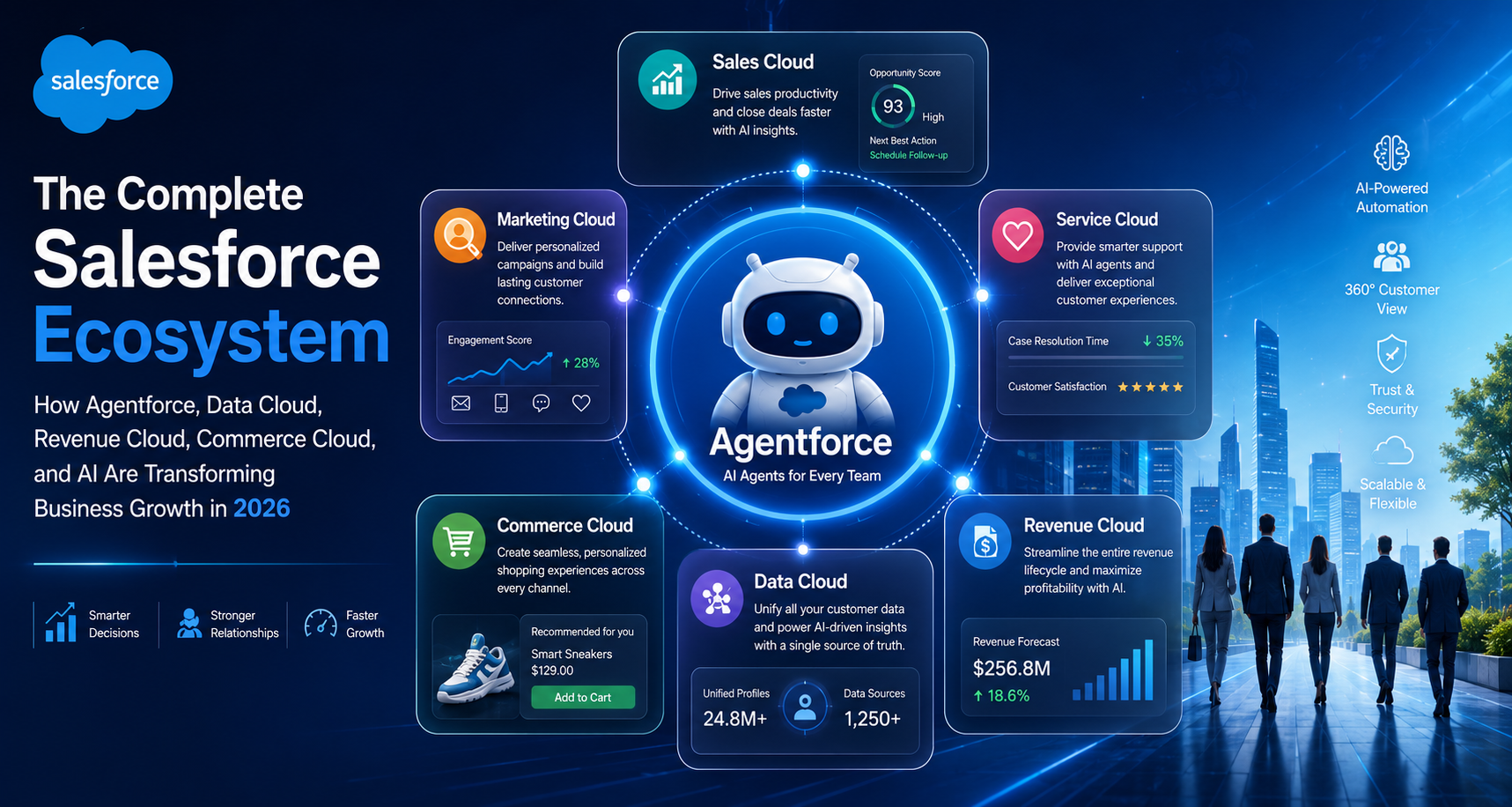
The Complete Salesforce Ecosystem Guide: How Agentforce, Data Cloud, Revenue Cloud, Commerce Cloud, and AI Are Transforming Business Growth in 2026
The business world is entering a new era where artificial intelligence, customer intelligence, automation, and connected digital experiences are no longer competitive advantages—they are business necessities. Organizations across the United States are investing heavily in technology platforms that help them improve customer engagement, accelerate revenue growth, streamline operations, and make data-driven decisions at scale.
At the center of this transformation is Salesforce, the world’s leading customer relationship management platform. What began as a cloud-based CRM solution has evolved into a complete business ecosystem capable of managing every stage of the customer lifecycle. In 2026, Salesforce is not simply a CRM platform. It is an intelligent enterprise operating system powered by AI, automation, analytics, and unified customer data.
The introduction of Agentforce, combined with innovations in Data Cloud, Revenue Cloud, Commerce Cloud, Sales Cloud, Service Cloud, and Marketing Cloud, has positioned Salesforce as one of the most influential platforms driving digital transformation worldwide.
Organizations that understand how these technologies work together are creating personalized customer experiences, improving operational efficiency, and unlocking new opportunities for growth. Businesses that fail to modernize risk falling behind competitors that are embracing AI-driven innovation and automation.
This comprehensive guide explores the complete Salesforce ecosystem and explains how Agentforce, Salesforce AI, Data Cloud, Revenue Cloud, Commerce Cloud, and related technologies are transforming business growth in 2026.
Understanding the Modern Salesforce Ecosystem
The Salesforce ecosystem has evolved significantly over the past decade. Traditional CRM systems primarily focused on managing contacts, tracking sales activities, and maintaining customer records. While those capabilities remain important, modern organizations require much more than simple customer data management.
Today’s businesses operate across multiple channels, platforms, and customer touchpoints. Customers expect personalized interactions whether they are engaging through websites, mobile applications, social media, ecommerce platforms, support channels, or sales representatives.
Salesforce addresses these challenges through an interconnected ecosystem that brings together customer data, AI intelligence, automation, analytics, and business processes into a unified platform.
Rather than functioning as separate applications, Salesforce products work together to create a single source of truth across the organization. Sales teams gain visibility into customer behavior, service teams access complete customer histories, marketers understand engagement patterns, and executives receive real-time business insights.
This connected architecture enables organizations to deliver seamless customer experiences while improving internal collaboration and decision-making.
Agentforce and the Rise of Autonomous Business Operations
One of the most significant developments within the Salesforce ecosystem is Agentforce. As organizations increasingly adopt artificial intelligence, they are moving beyond traditional automation and embracing autonomous AI agents capable of performing complex business tasks.
Agentforce represents Salesforce’s vision for AI-powered digital labor. Unlike conventional workflow automation tools that simply follow predefined rules, Agentforce agents can reason, analyze information, make recommendations, and execute actions across Salesforce applications.
These intelligent agents operate within established business frameworks while continuously learning from data and interactions. Organizations can deploy Agentforce across sales, customer service, marketing, ecommerce, and revenue operations.
In sales environments, Agentforce can identify high-priority opportunities, recommend next-best actions, generate outreach content, and automate routine administrative activities. Customer service departments use AI agents to summarize cases, suggest solutions, resolve common inquiries, and improve response times.
Marketing teams benefit from Agentforce through campaign optimization, customer segmentation, content recommendations, and audience analysis. Ecommerce organizations use AI agents to personalize shopping experiences and improve customer engagement.
As AI technology matures, Agentforce is becoming a central component of Salesforce business transformation strategies. Organizations are increasingly viewing AI agents as collaborative digital teammates that enhance human productivity rather than replace human expertise.
Salesforce Data Cloud as the Foundation of Customer Intelligence
Artificial intelligence is only as effective as the data that powers it. This reality makes Salesforce Data Cloud one of the most important components of the modern Salesforce ecosystem.
Most organizations struggle with fragmented customer information spread across multiple systems. Marketing platforms, ecommerce applications, customer support tools, sales databases, and external data sources often operate independently. This fragmentation creates incomplete customer profiles and limits business visibility.
Salesforce Data Cloud solves this challenge by creating a unified customer data platform that consolidates information from various sources into a comprehensive customer profile.
By connecting customer interactions across channels, Data Cloud provides organizations with a complete understanding of customer behavior, preferences, and engagement patterns. This unified view enables more accurate personalization, improved analytics, and more effective decision-making.
Data Cloud also plays a critical role in supporting Agentforce and Salesforce AI capabilities. AI agents rely on accurate, real-time customer information to generate meaningful recommendations and automate business processes effectively.
Organizations that successfully implement Salesforce Data Cloud gain significant advantages in customer experience management, marketing effectiveness, and operational efficiency. They can respond faster to changing customer needs and deliver highly personalized interactions at scale.
Salesforce AI and Predictive Intelligence
Artificial intelligence has become deeply embedded throughout the Salesforce ecosystem. Rather than existing as a standalone feature, Salesforce AI now influences nearly every aspect of customer relationship management and business operations.
Predictive analytics enables organizations to identify trends before they become obvious. Sales teams can forecast opportunities with greater accuracy, marketers can anticipate customer preferences, and service departments can proactively address potential issues.
Machine learning models continuously analyze customer behavior patterns, helping businesses identify churn risks, uncover upsell opportunities, and optimize engagement strategies.
Salesforce AI also supports decision intelligence by transforming complex datasets into actionable insights. Business leaders can access recommendations that help improve operational performance and support strategic planning.
The integration of AI across the Salesforce platform represents a significant shift in how organizations manage customer relationships. Rather than reacting to events after they occur, businesses can proactively influence outcomes through intelligent automation and predictive decision-making.
Revenue Cloud and the Evolution of Revenue Management
Revenue generation remains one of the most important objectives for any organization. Salesforce Revenue Cloud helps businesses optimize the entire revenue lifecycle from initial opportunity creation through contract management, billing, and revenue recognition.
Traditional revenue management often involves disconnected systems and manual processes that create inefficiencies and increase operational risks. Revenue Cloud addresses these challenges by creating a unified environment for managing revenue operations.
Organizations using Revenue Cloud can automate pricing strategies, streamline quote generation, accelerate contract approvals, and improve forecasting accuracy. These capabilities become even more powerful when combined with Salesforce AI and Agentforce.
AI-powered revenue forecasting enables organizations to identify potential revenue gaps before they occur. Intelligent pricing recommendations help businesses maximize profitability while maintaining competitiveness. Automated contract workflows reduce administrative burdens and accelerate deal closures.
As economic conditions become increasingly dynamic, organizations require greater visibility into revenue performance. Revenue Cloud provides the insights and automation needed to support sustainable growth and improve financial predictability.
Commerce Cloud and the Future of Digital Commerce
Ecommerce continues to play a central role in business growth strategies across industries. Customers expect seamless digital experiences that combine convenience, personalization, and consistency across channels.
Salesforce Commerce Cloud helps organizations meet these expectations by providing a scalable platform for managing digital commerce operations.
Modern consumers interact with brands across websites, mobile devices, marketplaces, social platforms, and physical locations. Commerce Cloud enables organizations to create unified shopping experiences that connect these touchpoints.
Artificial intelligence enhances Commerce Cloud through personalized product recommendations, intelligent search functionality, dynamic merchandising, and predictive customer insights. These capabilities help businesses improve conversion rates, increase customer retention, and drive revenue growth.
When integrated with Data Cloud, Commerce Cloud gains access to comprehensive customer profiles that support deeper personalization and more effective engagement strategies. Agentforce further enhances ecommerce operations by automating customer interactions and optimizing commerce workflows.
Organizations investing in Salesforce ecommerce solutions are creating highly responsive digital environments that adapt to changing customer preferences and market conditions.
Sales Cloud and Modern Revenue Growth Strategies
Sales Cloud remains one of the most widely adopted Salesforce products, but its capabilities have expanded significantly through AI integration and ecosystem connectivity.
Modern sales organizations require more than pipeline management. They need intelligent systems that help identify opportunities, prioritize activities, and improve forecasting accuracy.
Sales Cloud provides these capabilities through predictive analytics, automation, and AI-powered recommendations. Sales representatives gain access to actionable insights that help them engage prospects more effectively and accelerate sales cycles.
Agentforce further enhances sales operations by automating repetitive tasks, generating personalized communications, and identifying high-value opportunities.
Organizations that leverage Sales Cloud alongside Data Cloud, Revenue Cloud, and Agentforce create highly efficient sales environments capable of driving sustainable revenue growth.
Service Cloud and Customer Experience Transformation
Customer expectations continue to rise as digital experiences become increasingly sophisticated. Organizations must deliver fast, personalized, and consistent support across every channel.
Service Cloud enables businesses to meet these expectations through intelligent case management, omnichannel support, and AI-powered service capabilities.
Customers expect organizations to understand their history and preferences regardless of how they choose to engage. Service Cloud provides support teams with complete customer context, allowing them to resolve issues more effectively.
Agentforce supports service operations by automating routine inquiries, summarizing interactions, and recommending solutions. These capabilities improve response times while allowing service professionals to focus on more complex customer needs.
As customer experience becomes a key competitive differentiator, Service Cloud continues to play a critical role in Salesforce customer experience strategies.
Marketing Cloud and Personalized Customer Engagement
Marketing success increasingly depends on personalization, timing, and relevance. Generic campaigns no longer produce the results organizations require in highly competitive markets.
Marketing Cloud helps businesses create personalized customer journeys based on behavioral data, engagement history, and predictive analytics.
The platform enables organizations to deliver targeted communications across email, mobile, social media, and digital advertising channels. AI-driven insights help marketers understand customer preferences and optimize campaign performance.
Integration with Data Cloud allows Marketing Cloud to leverage comprehensive customer profiles for advanced segmentation and personalization. Agentforce enhances these capabilities by automating campaign management and identifying opportunities for engagement optimization.
Organizations that effectively combine Marketing Cloud, Data Cloud, and AI technologies can create highly relevant customer experiences that improve engagement and drive revenue growth.
Why Salesforce Ecosystem Integration Matters
The true power of Salesforce emerges when organizations connect multiple clouds into a unified ecosystem. While individual products deliver value independently, integration unlocks significantly greater business benefits.
Sales teams gain visibility into marketing interactions and customer service histories. Service agents access sales opportunities and commerce activity. Marketers leverage support data and purchasing behavior to create more relevant campaigns.
Data Cloud serves as the foundation for this connectivity by creating unified customer profiles. Agentforce operates across applications, automating workflows and providing intelligent recommendations. AI capabilities transform data into actionable insights throughout the organization.
This integrated approach eliminates silos, improves collaboration, and creates more consistent customer experiences.
Organizations that embrace the full Salesforce ecosystem are better positioned to respond to market changes, improve operational efficiency, and drive long-term growth.
The Role of Salesforce Consulting Services in Successful Transformation
Technology investments alone do not guarantee business success. Organizations must align technology capabilities with business objectives, operational processes, and customer expectations.
Successful Salesforce implementations require strategic planning, technical expertise, change management, and ongoing optimization. This is where Salesforce consulting services become essential.
Experienced Salesforce consultants help organizations identify opportunities, design scalable architectures, implement solutions efficiently, and maximize return on investment.
At DigiiQ, we work closely with businesses to develop customized Salesforce strategies that align with their unique goals and challenges. Our expertise spans Salesforce CRM implementation, Agentforce deployment, Data Cloud integration, Revenue Cloud optimization, Commerce Cloud development, and digital transformation initiatives.
By combining technical expertise with business strategy, organizations can accelerate adoption, reduce implementation risks, and achieve measurable outcomes.
Conclusion
The Salesforce ecosystem has evolved into one of the most comprehensive business transformation platforms available today. Through the combined power of Agentforce, Data Cloud, Revenue Cloud, Commerce Cloud, Sales Cloud, Service Cloud, Marketing Cloud, and Salesforce AI, organizations can create intelligent, connected, and scalable operations.
Businesses that embrace these technologies are improving customer experiences, optimizing revenue generation, automating workflows, and gaining deeper visibility into customer behavior. They are transforming data into actionable intelligence and using AI to drive more informed decisions.
As we move further into 2026, the organizations that thrive will be those that successfully integrate artificial intelligence, customer intelligence, automation, and digital commerce into unified business strategies.
Salesforce provides the foundation for this transformation, while experienced implementation partners like DigiiQ help organizations unlock the full potential of the platform. The future of business growth belongs to organizations that can combine technology, data, and customer-centric innovation into a connected digital ecosystem.
