






Salesforce Data Cloud in 2026: Building a Unified Customer Data Strategy for AI-Powered Growth
Data has become the most valuable asset for modern businesses, yet many organizations continue to struggle with fragmented customer information scattered across multiple systems. Sales teams maintain CRM records, marketing departments manage campaign platforms, ecommerce teams track purchasing behavior, and customer service representatives store support interactions in separate applications. The result is an incomplete view of the customer that limits business growth, reduces operational efficiency, and weakens customer experience.
As businesses move deeper into the era of artificial intelligence and digital transformation, the need for unified customer data has become more critical than ever. Organizations can no longer rely on disconnected systems if they want to deliver personalized experiences, automate decision-making, and gain meaningful insights from customer interactions.
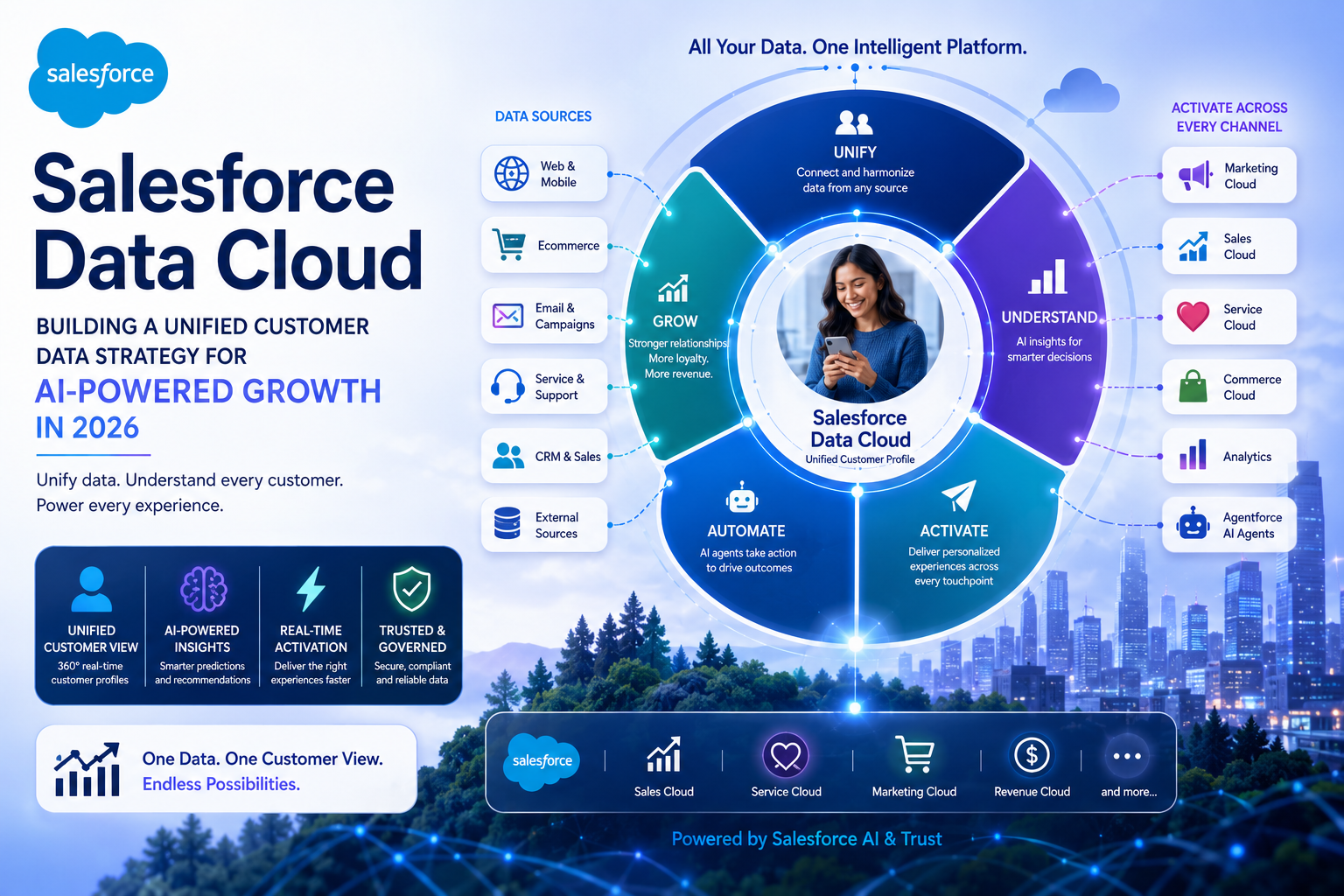
This is where Salesforce Data Cloud is transforming how businesses manage and utilize customer data. By creating a centralized, real-time customer data platform, Salesforce Data Cloud enables organizations to connect information across systems, build complete customer profiles, and power AI-driven business strategies.
For companies seeking to improve customer engagement, enhance operational efficiency, and maximize the value of their Salesforce investment, Data Cloud has become one of the most important technologies within the Salesforce ecosystem.
Understanding Salesforce Data Cloud
Salesforce Data Cloud is a customer data platform designed to unify customer information from multiple sources into a single, comprehensive view. Unlike traditional databases that simply store information, Data Cloud continuously ingests, harmonizes, and activates customer data across the organization.
Businesses often collect information from websites, ecommerce stores, mobile applications, marketing platforms, CRM systems, support channels, and third-party sources. While each system provides valuable insights, the data frequently exists in isolated environments that prevent organizations from understanding the complete customer journey.
Salesforce Data Cloud addresses this challenge by bringing together structured and unstructured data from various systems and transforming it into actionable intelligence.
Instead of viewing customers through separate departmental lenses, organizations gain access to a unified customer profile that reflects real-time behavior, preferences, engagement history, purchasing activity, and service interactions.
This holistic view creates the foundation for personalized customer experiences, advanced analytics, and AI-powered decision-making.
Why Unified Customer Data Matters in 2026
Customer expectations continue to evolve rapidly. Consumers expect businesses to recognize their preferences, understand their history, and provide relevant experiences regardless of the channel they choose.
When customer information remains fragmented, organizations struggle to meet these expectations. Marketing campaigns become less effective, sales opportunities are missed, customer service experiences become inconsistent, and decision-making suffers due to incomplete information.
A unified customer data strategy solves these challenges by creating a single source of truth for customer information.
Organizations can identify customer preferences more accurately, personalize interactions at scale, improve segmentation strategies, and create seamless experiences across every touchpoint.
In addition to improving customer engagement, unified data enables better business intelligence. Executives gain visibility into customer trends, revenue opportunities, and operational performance through accurate and comprehensive reporting.
As artificial intelligence becomes increasingly integrated into business operations, unified data is no longer optional. It is the foundation that enables AI systems to generate meaningful insights and recommendations.
How Salesforce Data Cloud Powers Artificial Intelligence
Artificial intelligence depends on high-quality data to deliver valuable outcomes. Even the most advanced AI models cannot generate accurate recommendations if they rely on incomplete or outdated information.
Salesforce Data Cloud serves as the intelligence layer that supports Salesforce AI, Agentforce, predictive analytics, and automation capabilities.
By creating a complete customer profile, Data Cloud provides AI systems with the context needed to understand customer behavior and make informed recommendations.
Sales teams can receive intelligent suggestions regarding which opportunities to prioritize. Marketing departments can predict customer preferences and optimize campaign targeting. Service teams can proactively identify customers at risk of churn and intervene before problems escalate.
Agentforce AI agents also rely heavily on Data Cloud to access real-time customer information. The more comprehensive and accurate the customer data, the more effective AI agents become at supporting business operations.
Organizations that combine Salesforce Data Cloud with AI-powered technologies gain a significant competitive advantage through faster decision-making, improved personalization, and enhanced operational efficiency.
Data Cloud and Salesforce Agentforce Integration
One of the most exciting developments within the Salesforce ecosystem is the integration between Data Cloud and Agentforce.
Agentforce represents Salesforce’s vision for autonomous AI agents capable of performing tasks, generating insights, and supporting employees across business functions.
However, AI agents require accurate information to operate effectively. Data Cloud provides the customer intelligence that powers Agentforce decision-making.
When a sales representative interacts with a prospect, Agentforce can analyze purchasing history, engagement data, previous conversations, and predictive insights stored within Data Cloud. This allows the AI agent to recommend personalized actions that improve conversion rates.
Customer service teams benefit similarly. Agentforce can access complete customer profiles through Data Cloud and provide relevant recommendations during support interactions.
Marketing teams gain access to AI-driven audience insights, helping them create highly targeted campaigns that improve engagement and return on investment.
The combination of Data Cloud and Agentforce creates a powerful environment where AI agents operate with complete customer context rather than isolated data points.
Salesforce Data Cloud for Customer Experience Transformation
Customer experience has become one of the most important factors influencing business success. Organizations that deliver personalized, consistent, and responsive experiences often outperform competitors in customer retention and revenue growth.
Salesforce Data Cloud enables customer experience transformation by creating a comprehensive understanding of each customer.
Rather than treating every interaction as an isolated event, organizations can view customer journeys as continuous experiences that span multiple channels and touchpoints.
A customer who browses products online, interacts with marketing emails, contacts customer support, and makes purchases through ecommerce platforms contributes valuable information to their unified profile.
Data Cloud consolidates these interactions, allowing businesses to understand customer intent and deliver more relevant experiences.
Personalization becomes significantly more effective because organizations can leverage complete customer histories rather than relying on limited datasets.
As customer expectations continue to rise, Data Cloud plays a critical role in helping businesses deliver the experiences modern consumers demand.
Supporting Salesforce Revenue Growth Through Data Intelligence
Revenue generation depends heavily on understanding customer behavior, identifying opportunities, and making informed decisions.
Salesforce Data Cloud contributes directly to revenue growth by improving visibility into customer relationships and purchasing patterns.
Sales teams gain access to comprehensive customer insights that help identify cross-sell and upsell opportunities. Marketing departments can target high-value audiences with greater precision. Customer success teams can recognize retention risks before they impact revenue.
Predictive analytics powered by unified customer data helps organizations forecast future outcomes and allocate resources more effectively.
Revenue Cloud and Data Cloud work together to create a connected revenue management environment. Organizations gain deeper visibility into pricing effectiveness, customer lifetime value, and revenue performance.
This intelligence supports strategic planning and enables businesses to optimize revenue generation efforts more effectively.
Salesforce Data Cloud and Ecommerce Innovation
Ecommerce organizations face unique challenges related to customer engagement, personalization, and conversion optimization.
Consumers expect highly personalized shopping experiences that reflect their interests, preferences, and purchasing behavior.
Salesforce Data Cloud enables ecommerce businesses to create these experiences by unifying customer information across channels.
Commerce Cloud can leverage Data Cloud insights to provide personalized product recommendations, dynamic merchandising strategies, and targeted promotional campaigns.
Organizations gain a better understanding of customer purchasing patterns, enabling them to optimize inventory planning, marketing strategies, and customer retention initiatives.
As ecommerce competition continues to increase, businesses that effectively utilize customer data gain significant advantages in customer acquisition and retention.
Implementation Considerations for Salesforce Data Cloud
Successful Salesforce Data Cloud implementation requires more than simply connecting systems. Organizations must establish a clear strategy for data governance, integration, and activation.
One of the most common challenges involves data quality. Inaccurate, duplicate, or incomplete records can reduce the effectiveness of analytics and AI initiatives.
Organizations should begin by evaluating existing data sources and identifying opportunities for improvement. Establishing governance standards ensures long-term data consistency and reliability.
Integration planning is equally important. Businesses must determine which systems will contribute data and how information will flow across the organization.
Security and compliance considerations should also remain a priority. Organizations must ensure that customer data is managed responsibly and in accordance with applicable regulations.
Partnering with experienced Salesforce consultants can significantly improve implementation outcomes and accelerate time-to-value.
Why Businesses Need Salesforce Data Cloud Consulting Expertise
While Salesforce Data Cloud provides powerful capabilities, maximizing its value requires strategic planning and technical expertise.
Many organizations struggle with data integration complexity, governance challenges, and activation strategies. Without proper guidance, businesses may fail to realize the full benefits of their investment.
Experienced Salesforce consulting partners help organizations design scalable architectures, integrate systems effectively, and align Data Cloud capabilities with business objectives.
At DigiiQ, we help organizations develop unified customer data strategies that support AI adoption, customer experience transformation, revenue optimization, and digital growth initiatives.
Our Salesforce consultants work closely with businesses to identify opportunities, streamline implementations, and create data-driven ecosystems that support long-term success.
Conclusion
Salesforce Data Cloud is redefining how organizations manage customer information in 2026. By creating a unified customer data platform, businesses can eliminate data silos, improve customer experiences, enhance decision-making, and power advanced AI capabilities.
As technologies such as Agentforce, predictive analytics, and intelligent automation continue to evolve, the importance of high-quality customer data will only increase. Organizations that invest in unified customer data strategies today will be better positioned to compete in increasingly data-driven markets.
Whether the goal is improving customer engagement, increasing revenue, optimizing ecommerce operations, or accelerating digital transformation, Salesforce Data Cloud provides the foundation for sustainable growth.
For businesses seeking to unlock the full potential of their customer data, partnering with an experienced Salesforce consulting provider like DigiiQ can help ensure a successful implementation and long-term business value.
