






Comprehensive Guide to Custom Salesforce Development: Capabilities, Advantages, and Strategic Practices for 2026
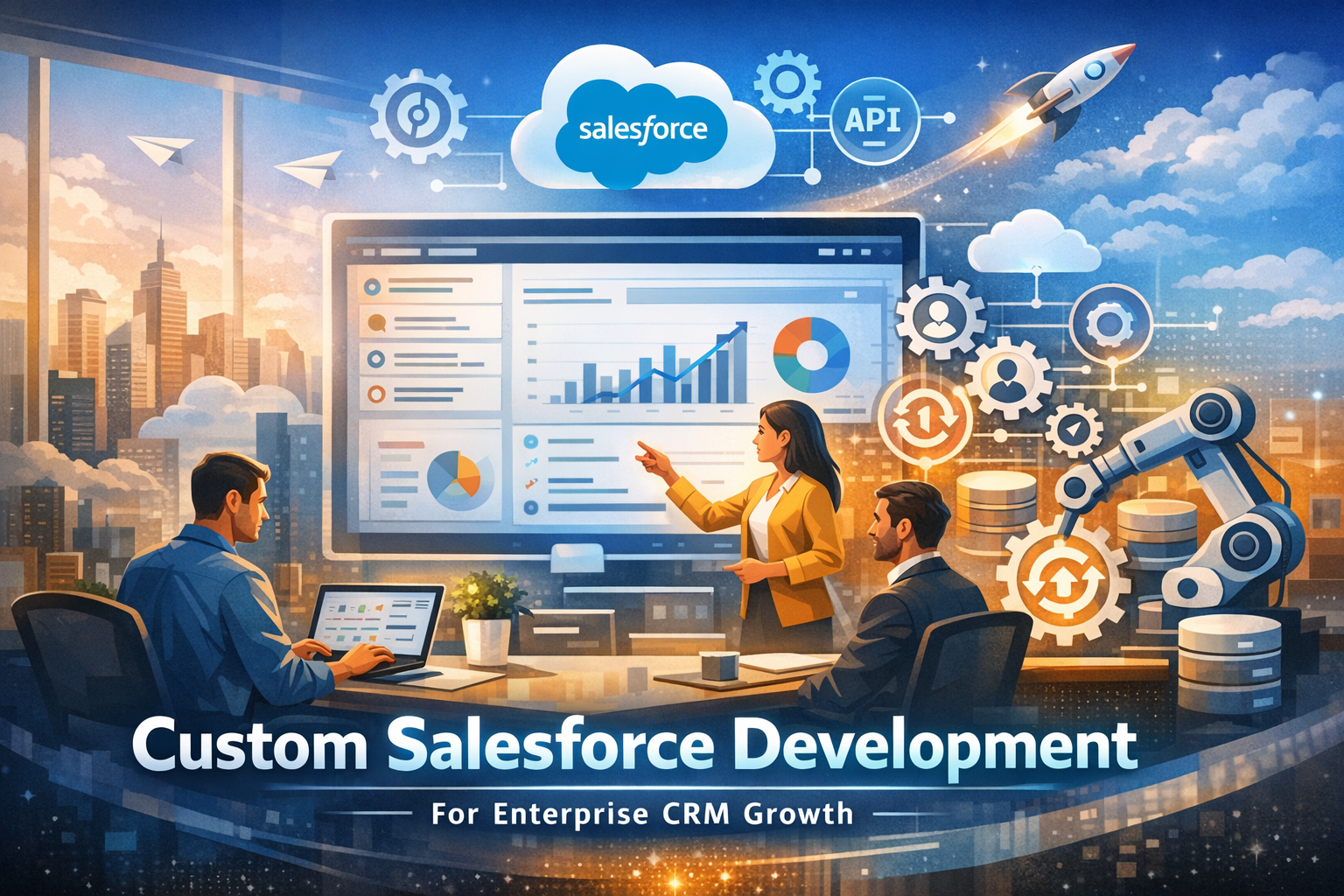
Custom Salesforce development 2026 is transforming how enterprises build scalable, secure, and automation-driven CRM systems for long-term growth. It is estimated that the necessity of personal Salesforce development will grow even more in 2026. Given that businesses expand in size or become more complex, the systems that represent their unique processes and goals are also demanded. This is because no universal Salesforce is set up that fits all the organizations setups and workflow needs.
Custom Salesforce Development allows organisations to build solutions to expose their unique processes, operational models and functional needs. When an established Salesforce solution is put in place successfully, staff groups will be able to increase efficiency, boost output, and provide customers with better experiences. That is why, it becomes an important business priority to find a reputable provider of Salesforce CRM development services.
This guide discusses the fundamental elements of the custom Salesforce development, the most prominent benefits that it provides, and the strategic best practices that organizations must pursue. As a business owner, head of a department, or any other person looking to analyze how Salesforce development solutions can help your firm grow, the guide is aimed at giving you the clarity.
What Is Custom Salesforce Development in 2026?

Custom Salesforce Development entails the creation of custom tools, workflows and functional additions on the Salesforce platform. This system offers many in-built features usually known as out-of-the-box features, which are needed to facilitate the general business functions. Salesforce however does not get used in the same way by every organization and the general functionalities may not necessarily fit the organization structure of a given organization.
Flexibility is the main goal of businesses that invest into Custom Salesforce Development. Rather than adjusting their internal operations to accommodate the readymade CRM settings, firms are able to create Salesforce environments that are directly suitable to their operations. This strategy will give the platform a direction on which the organization is strategic as opposed to restraining it.
Salesforce development assists companies to work faster and more efficiently by allowing customization of workflows in all of their sales, service, and marketing activities. Real-time KPI monitoring can also be integrated in order to enable leaders to monitor the performance instantly and make decisions based on the obtained data without any delays. A trustworthy Salesforce developing company will make sure that the system is scalable to the adaptability of changes in the business in the future.
Why Invest in Custom Salesforce Development — Core Benefits
Tailor made CRM solutions enable institutions to create systems that are exactly what they need in terms of operations. Custom Salesforce development stands to be useful to both the developing business and the developed business. Organizations can enhance efficiency and accelerate internal operations using custom applications, processes, and automation without compelling teams to change according to defined system constraints.
In its customization, Salesforce serves a vast industry, such as retail, manufacturing, healthcare industry, financial services, and professional services. Every industry has its own workflows based on the type of operation and the requirement of compliance to that industry. CRM environment focuses on individual needs of businesses, which enables the organization to get a CRM environment that reflects its actual style of working.
Another big benefit of Salesforce customization is effective data management. Businesses are able to keep correct, structured and reliable datasets by centralizing the information in one system. Clean data enhances the quality of reporting and makes sure that the teams work with the same information.
The availability of correct data facilitates improved decision-making. The data quality facilities offered by Salesforce enable companies to keep their records clean and the automation feature minimizes manual work. This enhances effectiveness of operation and errors are reduced within the department.
The visibility of key performance indicators is clear on custom Salesforce reporting dashboards. Real-time measures enable leadership and sales departments to evaluate performance, trends and make changes promptly.
Salesforce automation saves time and eliminates manual repetitive tasks. Organizations can standardize operations with the help of such tools as Apex, workflow rules and process automation and increase accuracy and productivity.
Scalable Salesforce structure runs over the long-term. Businesses are able to increase user access, data volume and functionality without restructuring the whole system. Salesforce customization allows the expansion to be done in modules as business requirements change.
Bespoke Salesforce applications can be connected with the third-party system, including ERP system, marketing software, eCommerce applications, and communication software. The API-based integrations remove the data silos and provide a reliable flow of information throughout the departments.
A personalized user interface enhances usage and adoption. It is possible to create Salesforce Lightning Components and Visualforce pages according to the user roles and make sure that employees will only be presented with the features that matter. Role based access eliminates navigation and enhances productivity.
Customization helps to enhance security and compliance. Organizations are able to utilize accurate access controls, audit trails, and compliance controls to secure sensitive business and customer information.
Custom Salesforce solutions will over time minimize reliance on third-party solutions and manual operations. Automation and streamlined workflows provide cost-efficiency in the long-term and return on investment.
Key Components & Technical Stack for Effective Customization

Salesforce has a custom logic and data handling based on Apex and SOQL. Apex is a proprietary programming language allowing organizations to model business rules, automate business processes and impose operational logic throughout the CRM. SOQL enables the teams to access, filter, and analyze Salesforce data effectively in a way that data will be available when needed.
Both Visualforce and Lightning Web Components are utilized to develop a personalized user interface and user experience. Such technologies assist in creating state-of-the-art responsive pages that enhance usability and performance of the systems. Developed dashboards and interfaces enable the user to retrieve important information in a very short time, enhancing productivity and decision-making.
Salesforce APIs are important because they facilitate integration of Salesforce with the external systems, which include ERP software, marketing automation applications, eCommerce, and internal business applications. The API-based integrations will make the data synchronization real-time, minimize the need to enter the data manually, and receive a single picture of the functioning between the systems.
The security and compliance modules provide the protection of data and compliance with regulations. Role-based access control which is designed to meet industry and compliance requirements, audit trails and data protection stretches to ensure that the sensitive information is securely safeguarded within an organization.
Best Practices & Common Pitfalls in Custom Salesforce Development
It is necessary to define clear requirements prior to a customization project beginning. Organizations may lose control of scope and time and beget lost results without a well documented scope and objectives. Identified requirements give a sound baseline and align the development activities with the business objectives.
To preserve performance it is important to optimize the code and system architecture. Apex code that is not written well, poorly-written SOQL queries, or too many triggers may cause the performance bottleneck, and governor limit problems. Scalable design, code reviews and best practice can assist in maintaining the stability of the systems.
Long-term maintenance, updates and support planning are usually neglected. The Salesforce solutions which are custom require constant monitoring, compliancy upgrades, and performance tuning to stay effective as Salesforce updates are introduced.
These factors as security and compliance need to be taken into consideration at the very start of the development process. Early implementation of role-based access controls, audit logs and data protection mechanisms will minimize the risk and regulatory alignment.
It is important to have a balance between personalization and simplicity. Excessive customization may make it more complex and less usable, as well as more difficult to upgrade in the future. Good Salesforce solutions are clear, fast and serviceable.
How to Choose the Right Salesforce Development Partner / Company?
The choice of Salesforce partner is a very important part of any successful project based on the customization. The overall experience of the provider, technical proficiency, and the capacity to offer credible services during the entire project life cycle should be considered by the organizations. An effective development partner has knowledge about Salesforce functionality and business issues in actual sense.
The capability can be indicated by professional certifications and practical experience in Salesforce products, which include Sales Cloud, Service Cloud and Marketing Cloud. Professionals who have been certified will be in a better position to develop solutions that are in line with the business goals and Salesforce best practices.
The past projects and the feedback of clients will give an idea of the quality of delivery and knowledge of the industry among the partners. Organizations need to determine whether the provider has been effective in providing solutions that are similar in complexity and scope of the one that the organization requires.
The development of Salesforce can also be outsourced with the access to the specialized skills and scalable resources. Businesses must also establish scope of projects, make specific demands on cost estimates, and verify availability of post-launch support and maintenance services before choosing a partner to guarantee the success of business in the long run.
Custom Salesforce Development vs Standard CRM Setup
Principles of Standard CRM setup are intended to complement the generic business operations at minimum setup. Such out-of-the-box solutions can be installed with less effort and need less customization out-of-the-box. A standard configuration can be acceptable in cases where the organizations have simple work process and do not require much integration.
Nevertheless, any business that has complex workflow, advanced reporting requirements or system integrations can be limited by the conventional CRM configurations. Custom Salesforce development offers the flexibility to workflow design, logic automation, and data model design to match the unique operational needs.
In contrast to standardized CRM systems, custom Salesforce environments change with organizational development. Firms are able to add new modules, increase access by users, add systems and alter workflows without having to recreate the entire platform.
Standard setup or customization is subject to the scale of business, the complexity of its operations, and the expansion goals in the long-term. A tailored Salesforce solution is usually more valuable to organizations that are planning to grow in the long term.
When Does Custom Salesforce Development Make Sense — Use Cases & Buyer Signals
Companies with steep growth or those constantly changing processes, tend to find the standard CRM set-ups no longer work to suit them. With the changing processes, tailored Salesforce development assists in eliminating the bottle necks and enhancing team coordination.
Custom Salesforce APIs are of great use to businesses that need to have connectivity with third-party solution applications like ERP systems, marketing automation solutions, eCommerce solutions, and other systems. Immediate exchange of data eliminates redundancy of work and enhances visibility of operations.
Organisations that have intricate reporting needs or high levels of compliance demands normally need customised Salesforce solutions. A custom security model, audit trails and reporting structures are useful in enabling organizations to remain within the boundaries of regulations and to secure sensitive information.
Individual Salesforce development is also best suited to the company with long term expansion plans. With the growing business requirements, tailor-made solutions can enable teams to add value, automate high-level features, and still perform without recording systems.
Getting Started — Steps to Launch a Custom Salesforce Project
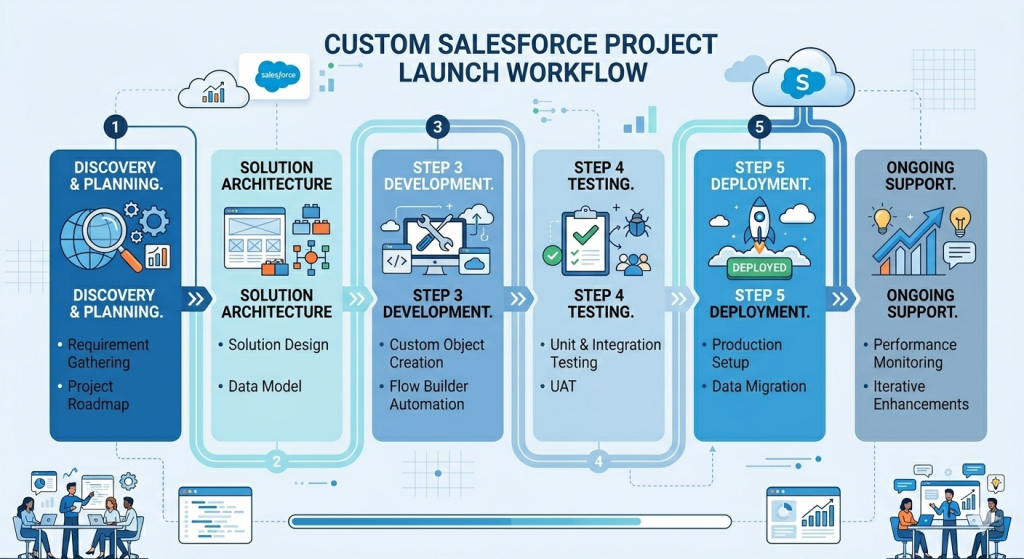
- The initial process of executing a bespoke Salesforce project is the process of collecting specifications. To get the solution that meets the actual operational requirements, the organization should clearly comprehend their business processes and that workflows should be documented. When it is planned well at this point, there is less rework and misalignment in the project at a later stage.
- The second one is to choose a trusted Salesforce development partner. Companies are required to seek qualified individuals that have a background of undertaking a similar project. A well informed partner assists in converting business needs into technical solutions that are scalable.
- After defining the requirements, the solution architecture is designed. This involves the design of data models, system integrations and user interface designs that will be sustained over time growth and usability.
- The application of Salesforce technologies Apex code written in business logic, Lightning Components used to write modern user interfaces, SOQL used to access data, and APIs used to connect with other systems follow development.
- The testing and quality assurance help ascertain that the solution is reliable, secure and functional as per the expectations. The user training is used to assist in adoption and effective use of the system after deployment.
- With continuous maintenance, updates and performance monitoring, the Salesforce solution is secure, scalable and in line with changing business requirements.
Common Mistakes to Avoid in Custom Salesforce Projects
A lack of defined requirements or a long-range roadmap before starting a Salesforce project is one of the most widespread problems that organizations struggle with. In situations where goals are not clear, projects tend to get delayed, suffer a budget overrun and inconsistent results. The ability of developers to have goals gives them a sense of direction and makes the solution relevant in the long run.
The other common error is the overloading of Salesforce with too much custom logic, workflow or triggering. Excessive customization may have adverse effects on the performance of the system and put it at risk of making errors. Governor limit problems can also be caused by poorly optimised Apex code or the use of inefficient SOQL queries.
Failure to maintain continuously is another significant risk. Salesforce solutions may be unstable or not able to upgrade to the future without regular updating, performance reviews, and compatibility check.
Security management is especially dangerous to entities that deal with sensitive or controlled information. The inability to establish role-based access, audit logging and compliance could leave the systems vulnerable to security risks.
Selecting a relatively new Salesforce development company may lead to a low level of the implementation quality and inadequate support after launching. These risks can be mitigated by choosing certified partners who have a good record of experience.
To Conclude
Custom Salesforce development is a long term solution that is gaining popularity among organizations that have to enhance productivity, collaboration, and operational efficiency. Salesforce customization helps to achieve smarter decisions and operational consistency by centralizing the data, automating the workflows, and providing real-time visibility across departments.
Businesses have to focus on the complexity of the workflow, integration requirements, and expansion strategies when analyzing the appropriate customization strategy. The flexibility and scalability needed by enterprise level CRM systems in 2026 and beyond depends on custom Salesforce development.
The collaboration with a skilled Salesforce development company will guarantee that the organizations will be able to build secure, scalable, and efficient CRM solutions that will address the needs of the organizations. Using a proper plan and implementation, custom Salesforce development would bring quantifiable business worth and long-term growth. Refrence Salesforce Official Docs
Frequently Asked Questions About Custom Salesforce Development
What does custom Salesforce development actually involve?
Custom Salesforce development involves the creation of customized workflows, applications and interfaces that are in line with the particular business processes of an organization. It enables the companies to customize Salesforce to fit the manner in which they operate instead of altering internal operations to accommodate standard configurations.
How much does custom Salesforce development typically cost?
Depending on the scope, complexity, and integration needs, Salesforce customization is costly. The smaller improvements can be less expensive whereas larger enterprise level implementation with integrations and automation will be more expensive depending on the time of development.
How do I know if my business needs customization or standard Salesforce setup?
Simple workflow can be done on simple Salesforce configuration. The custom development is required in situations where businesses are in need of sophisticated automation, complicated reporting, or integrations that normal configurations cannot fulfill.
Which technologies are used in Salesforce custom development?
Business logic Apex is commonly used to customize Salesforce, SOQL is a data querying language, Lightning Components are used to build modern user interfaces, and APIs are used to integrate Salesforce with external systems.
How long does a Salesforce customization project usually take?
The project timelines will be based on complexity. Minor changes can consume several days and more significant bespoke projects that involve several integrations and testing processes can take several weeks or even several months.
Will a custom Salesforce solution scale as my business grows?
Yes. Properly designed Salesforce applications can grow with the growth in user base, data and functionality with ease, without the need to rewrite an entire system.
How is data security maintained in a custom Salesforce environment?
Role-based access controls, encryption, audit trails and compliance models are used to guarantee security and safeguard sensitive data and comply with regulatory requirements.
What are the most common risks in custom Salesforce projects?
The unclear requirement, over-customization, incomplete documentation, maintenance, and the fact that the development partners are less experienced are common risks.
How should I choose the right Salesforce development company?
The organizations are to find certified specialists who have the experience of the success and demonstrated their abilities to communicate clearly, to be related to the industry, and to provide the supports after the launch.
What post-launch support is required after customization?
After sales services involve bug fixes, system upgrades, performance checkups, user training and continuous upgrades according to the business requirement.
