






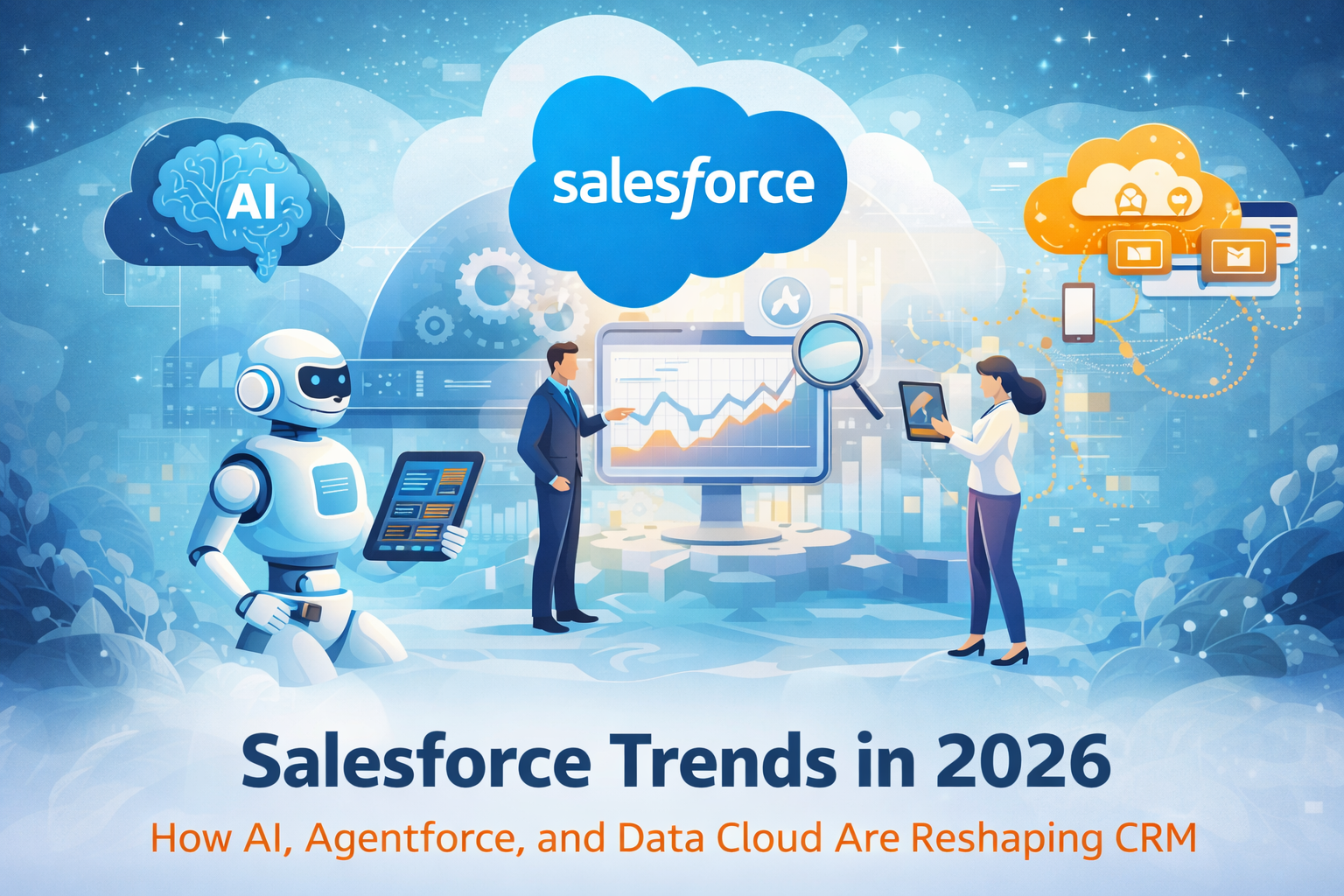
Salesforce Trends in 2026: How AI, Agentforce, and Data Cloud Are Reshaping CRM
Introduction
The customer relationship management is also changing quickly with the businesses embracing highly advanced technologies in order to enhance customer experiences, mechanize operations, and derive insights more by using the data. By 2026, companies are not using CRM platforms merely to keep the information about customers. They are instead turning CRM into smart ecosystems that help them make decisions in real-time and engage real individuals.
Salesforce remains at the forefront of this transformation, with such innovations as Agentforce, Salesforce Data Cloud, Einstein AI, and AI-driven automation frameworks. The ways these technologies enable companies to consolidate customer data, automate processes, and create personal experiences in all digital channels are unclear.
These innovative Salesforce features are becoming highly necessary to organizations who want to be competitive in the contemporary digital economy. Those companies that embrace the use of intelligent CRM systems are in a position to enhance productivity, customer relationship and business growth.
At DigiIQ, we assist companies in adopting current Salesforce solutions that can integrate AI, automation, and data intelligence to establish scalable and high-performance CRM platforms. As discussed in this article, the key Salesforce tendencies dictating CRM in 2026 and how businesses can capitalize on the tendencies will be examined.
The Evolution of Salesforce CRM
When Salesforce was launched, it was a cloud-based CRM application that was to be used by enterprises to facilitate customer contacts and monitor their sales operations. The platform has grown to be a full-fledged digital ecosystem in the last twenty years to enable sales, marketing, customer relationship, analytics, and application development.
The Salesforce platform today offers organizations an integrated platform upon which customer data, business processes, and AI-based insights collaborate. This transition in the old system of CRM to smart customer platforms is transforming the nature of interaction of companies with their customers.
With the adoption of AI-based applications like Einstein AI, Agentforce and Data Cloud, Salesforce can no longer afford to remain merely a provider of automation. These solutions enable companies to understand the customer behaviour, forecast the future results and automate the complex processes.
By 2026, Salesforce CRM will not be merely a customer data management tool, it is also becoming a strategic platform, which will enable the digital transformation efforts in industries.
Agentforce: The Rise of Intelligent Digital Agents
The new framework that has gained the strongest potential in the Salesforce ecosystem is Agentforce which is created to bring AI-driven digital agents into the business processes.
The use of agentforce allows organizations to launch smart agents capable of doing some duties previously performed by human teams. With the assistance of AI, these agents have the ability to process customer data, automate routine processes, and offer real-time suggestions in order to enhance business performance.
Considering the examples, an Agentforce agent will be able to automatically qualify leads, generate priorities of sales opportunities and indicate the most optimal steps to be taken by sales representatives. Digital agents may support the work of the support team by analyzing received cases and proposing solutions in the customer service area based on the previous data.
The fact that AI agents can be directly incorporated into Salesforce processes enables companies to work more effectively without sacrificing the quality of their communication with clients.
With the continuous adoption of AI automation by more organizations, Agentforce will be instrumental in changing CRM systems into intelligent operations platforms.
Salesforce Data Cloud and the Power of Unified Customer Data
Information is the base of the new digital experiences. Nevertheless, most companies have the problem of disjointed data which is spread on various systems like CRM systems, marketing software, websites, and mobile apps.
Salesforce Data Cloud can help the company deal with this issue by establishing a centralized platform where companies can consolidate customer data across various sources.
Data Cloud is made out of the data obtained in sales, marketing, service, and external platform which allows forming a picture of every customer. This integrated customer image helps the organizations to know the behavioral pattern and the preferences as well as the history of engagement more aptly.
Companies are becoming more and more reliant on Data Cloud to support highly intelligent analytics, personalization initiatives, and AI-focused automation in 2026.
Combined with Salesforce AI technologies, coordinated data permits foreseeable revelation to aid companies infer customer requirements and provide more applicable experiences.
Artificial Intelligence in Salesforce: From Insights to Automation
The Salesforce ecosystem has made artificial intelligence one of its core elements. Salesforce Einstein AI enables companies to process huge amounts of customer data and produce insights that are used to enhance decision-making.
With the help of AI, one may determine the trends in customer behavior, predict the possibilities of sales, and suggest the marketing strategies through data analysis. Rather than slow decisions made manually, businesses can draw on insights provided by AI to make quicker and more correct decisions.
Automation is one other significant advantage of AI in Salesforce. AI algorithms can be applied to tasks like lead scoring, customer segmentation, service case routing, and other activities.
This automation assists organizations to ease manual workloads in addition to enhancing efficiency in their operations. Sales teams are able to concentrate on the closing of deals, marketing teams are able to create more targeted campaigns and service agents are able to settle customer problems quicker.
AI technology is also going to become more critical in Salesforce as it is bound to advance further, turning the CRM platforms to become smarter and more responsible.
Transforming Sales Operations with Salesforce AI
Sales teams have been putting pressure on locating new opportunities, patronizing customer relations, and conclusive deals within a short time. The Salesforce AI technologies are assisting companies to redesign their sales process as it delivers real-time insights and predictive analytics to companies.
Artificial intelligence applications are able to sift through customer interactions and receive leads that have the highest chance of turning into paying customers. This gives the opportunity to the sales representatives to focus on high value opportunities and spend their time where they can best perform.
Predictive analytics is also useful in enabling businesses to predict revenues. Salesforce AI is able to make valid predictions based on historical sales records and customer behavioral patterns that can be used in strategic planning.
The automation of agentforce also helps in improving the sales productivity by automatically updating the CRM records, making follow-ups and producing performance reports.
Through these smart features, the sales teams will be able to operate more effectively and perform better.
Modernizing Customer Service with Intelligent Automation
Another field that Salesforce innovative products are making a profound difference with regards to improving customer service. The needs of the modern customer are to receive quick feedback and custom-made service through various communication channels.
It is the ability of Salesforce Service Cloud, integrated with AI and Agentforce, to provide businesses with the ability to match these expectations by delivering modern support experiences.
The chatbots and digital agents powered by AI can cope with the routine questions of the customers: order tracking, updates on their accounts, and inquiries about products. This saves the human agents the workload and the customers are also served promptly.
The service teams can also be served by agentforce through automatic routing cases to the most suitable support agents depending on the type of issue and the expertise.
Moreover, AI-based knowledge systems can give solutions to the agent in the course of interaction with the customer and assist them to solve problems quicker and enhance customer satisfaction.
These inventions enable companies to offer effective and scalable customer support services.
Personalizing Marketing with Salesforce Marketing Cloud
Marketing approaches of the future (2026) are more and more data-driven. Companies should learn how to cater to the needs of the customer and provide a personal experience through digital platforms.
Salesforce Marketing Cloud enables companies to create personalized marketing campaigns with the help of sophisticated segmentation, automation and analytics applications.
Through the Data Cloud and AI adoption, marketers will be able to get a single view of customer data and develop a very individual approach to engagement.
Predictive analytics aids in identifying the most relevant messages to be used among particular audiences whereas campaign execution is facilitated by automation tools on email, social media, mobile messaging, and digital advertising platforms.
Using the integration of data insights and marketing automation, businesses will be enabled to develop better relations with their customers and enhance the performance of campaigns.
Why Businesses Are Investing in Salesforce in 2026
Businesses in various sectors are also investing more in Salesforce due to the benefits that the product presents in the current digital business world.
The scalability is one of the most important advantages. Salesforce solutions have the ability to expand with the requirements of a company, processing both start ups and multinational companies.
Integration is another of the benefits. Salesforce is able to integrate with a large set of business applications, such as ERP systems, marketing platforms, analytics solutions, and customer support solutions.
Firms also enjoy the benefit of incessant innovation in the Salesforce ecosystem. Agentsforce, AI automation, and integrated data platforms are new technologies that keep organizations competitive in the changing digital environment.
Organizations that embrace these new Salesforce solutions are able to become more efficient in their operations, provide superior customer experiences, and become successful in the long-term business.
Conclusion
The future of customer relationship management is still determined by Salesforce which introduces new technologies that integrate artificial intelligence along with automation and unified data platforms.
The use of innovations like Agentforce, Salesforce Data Cloud and Einstein AI are changing CRM systems to intelligent business platforms that facilitate real time decision making and personalized engagement in the year 2026.
Those organizations that adopt these technologies will be able to stream business activities, enhance customer satisfaction as well as open new growth prospects.
In DigiIQ, we assist in the deployment of modern Salesforce solutions to businesses in line with their strategic objectives and digital transformation efforts. Our Salesforce specialists will make sure that organizations may use the power of the Salesforce ecosystem to its fullest extent, whether it is CRM consulting and implementation, AI integration, or enterprise automation.
With the ongoing changes in the digital world, the use of smart Salesforce technologies will be a necessity among businesses that are interested in being in front of the race and providing extraordinary customer experiences.
