






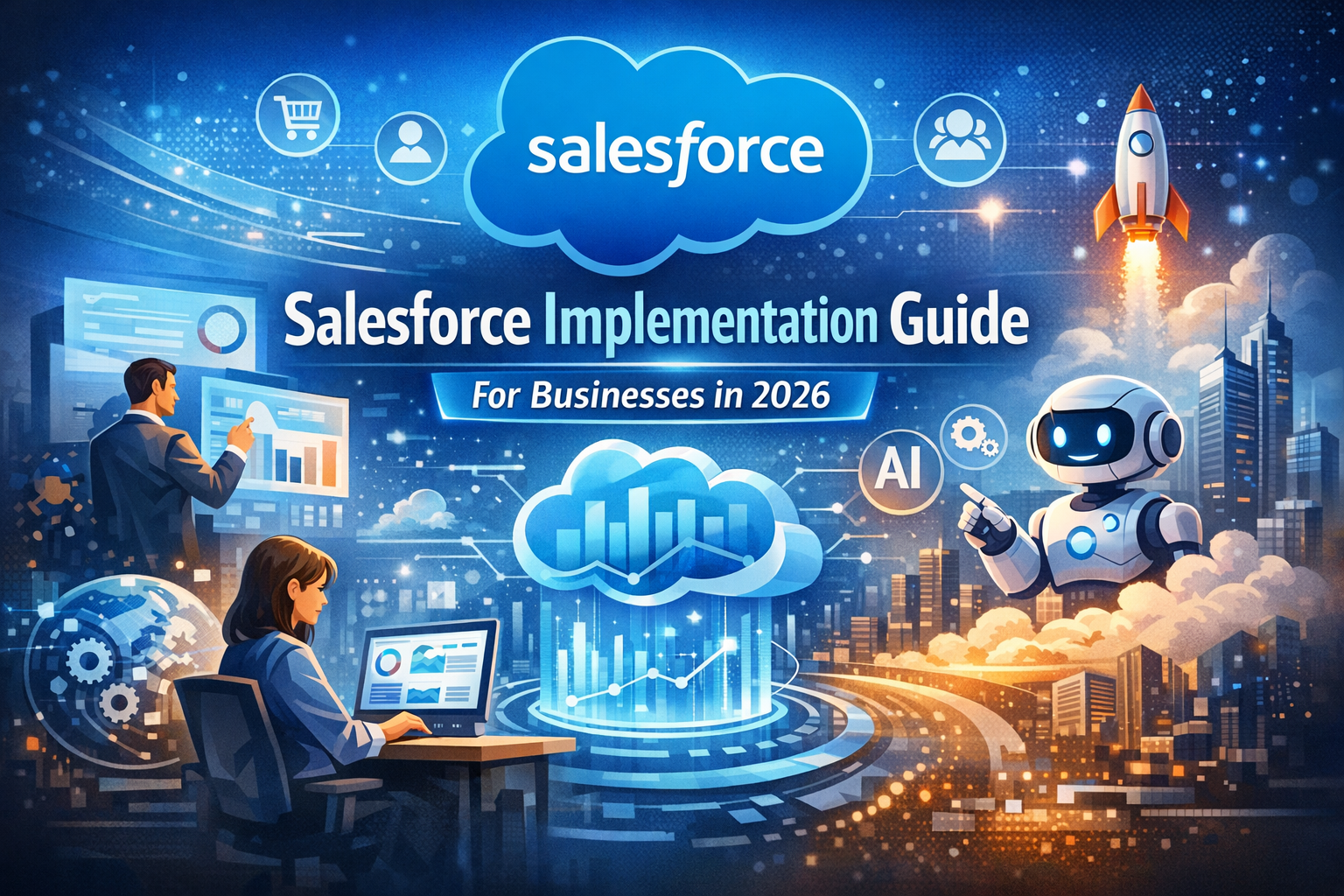
Salesforce Implementation Guide for Businesses in 2026: Strategy, Benefits, and Best Practices
Introduction to Salesforce and Modern Business Transformation
Digital transformation is no longer a choice in contemporary businesses. In the business world, companies in various sectors are embracing the use of cloud based technologies to enhance customer relationships, streamline business and make more profits. The Salesforce, which is the most popular customer relationship management (CRM) platform in the world, has remained one of the platforms that have spearheaded this transformation.
The Salesforce offers businesses the ability to execute sales, marketing, customer services, analytics and application development in one cloud based environment. Salesforce is used by companies of any size, whether it is a start up or a global enterprise, to understand customers better, automate routine business processes, and provide personalised customer experiences.
Digiiq.com is a company that assists organizations to realize the full power of Salesforce by providing expert implementation, customization, integration, and consulting services. This is a comprehensive guide that aims to discuss Salesforce implementation strategies, benefits, best practices and how businesses can use the platform to grow over the long term.
What is Salesforce CRM?
Salesforce is a CRM cloud-based application that is used to assist organizations to better manage the relationships with their customers. Rather than using spreadsheets or isolated systems, Salesforce gathers both customer information and business operations in one platform that one can access anywhere.
The platform offers an opportunity to manage leads, opportunities, contacts, customer support cases, marketing campaigns and analytics dashboard. It is also possible to use Salesforce capabilities by businesses to create personal applications and automate workflows.
Since Salesforce is all cloud, firms do not have to have complicated infrastructure and servers. Automatic update and improvement will be provided and the organizations will be able to be in touch with new technology innovations.
Salesforce has been developed further than just a CRM system today. It has now been a fully functioning business platform comprising sales automation, marketing automation, artificial intelligence, customer service management, and application development tools.
Why Businesses Choose Salesforce
Companies worldwide implement Salesforce due to the fact that it helps the company to better handle customer relations as well as enhance productivity among employees.
Scalability is one of the main factors why business people prefer Salesforce. Salesforce can expand as an organization, regardless of its size, of ten employees or ten thousand employees. Companies also have the opportunity to begin with simpler CRM features and upgrade to more advanced automation, analytics, and AI.
The other important benefit is that the platform is capable of centralizing data. The same real-time customer information can be accessed by sales teams, marketing departments and customer service agents. This shared perception enhances cooperation and helps to achieve homogenous and customized customer experiences.
Salesforce is also capable of providing strong automation capabilities which minimize manual work. Monotonous tasks like lead assignment, emails and approval workflows can be automated and employees will be able to concentrate on high value activities that result in revenue.
Key Salesforce Products Every Business Should Know
There are various cloud products provided by Salesforce, which are applicable to various business functions. These are products that are interoperable with Salesforce.

Sales Cloud
Sales Cloud services will assist in managing leads, opportunities, and customer relationships more efficiently by the sales teams. It offers the opportunities of pipeline tracking, sales forecasting, automation of tasks, and performance analytics. Through Sales Cloud, salespeople will have a chance to prioritize the leads, track the deals, and close the opportunity quicker.
Service Cloud
Service Cloud services deals with case management and customer support. It also enables companies to provide customers with quicker and more personal services, using functions like case tracking, knowledge bases, chat support, and automated processes. Customer service agents are able to retrieve a full history of the customer, and this assists them in solving problems very fast.
Marketing Cloud
Marketing Cloud services assists companies to develop precise marketing campaigns on different channels, such as email, social media, and mobile messaging. Companies can divide audiences, target communications, and monitor the performance of campaigns to increase the rate of marketing.
Commerce Cloud
Commerce Cloud services help businesses to create an active web-based shopping experience. The Salesforce ecosystem provides companies with the ability to maintain product catalogs, customer data and process orders, thereby forming a single commerce platform.
Experience Cloud
Experience Cloud services enables companies to create customer, partner, and employee portals in the digital realm. Such portals are applicable in self-service support, collaborating with partners, and engaging the community.
Benefits of Salesforce Implementation
Salesforce adoption can bring numerous benefits to companies that want to enhance customer interaction and efficiency of business operations.
Improved Customer Relationship Management
Salesforce gives a full-degree customer landscape where all the interactions, communications and transactions are combined into one platform. This centralized customer profile enables companies to know the needs of their customers and provide them with more personalised services.
Enhanced Productivity
The Salesforce automation tools remove redundant manual work like data entry and allocation of leads. The employees are able to concentrate on the strategic activities including relationship building, problem-solving, and revenue generation.
Data-Driven Decision Making
Salesforce also contains robust reporting and analytics that are useful in enabling organizations to make evidence-based decisions. Real-time dashboards help managers to track sales performance, identify trends and predict future revenue.
Seamless Collaboration
Since all the information about the customers is gathered in a single location at Salesforce, interdepartmental teams are able to work more efficiently. It allows the sales teams, marketing and support teams to share their insights and coordinate with each other in order to enhance customer satisfaction.
Scalability and Flexibility
Salesforce is very personalized and can be scaled. As businesses are developed, they can add new features, users, and integrations. Thousands of third-party applications are also supported on the Salesforce AppExchange marketplace on the platform.
Salesforce Implementation Process
Salesforce implementation is a complex task that must be properly planned and executed. An implementation strategy helps organizations to achieve maximum benefit by the investment made on CRM.

Business Requirements Analysis
The initial point of Salesforce implementation is the realization of business goals and requirements. This includes the studying of the current workflows, pinpointing the points of pain, and how Salesforce will enhance the processes.
In Digiiq.com, Salesforce consultants collaborate with the stakeholders to establish specific aims to the implementation project. This phase will make sure that the system is developed to satisfy certain business requirements.
Salesforce Configuration and Customization
After the requirements are outlined, Salesforce is implemented to fit the workflows of an organization. This involves developing business-specific objects, fields, and automation regulations as well as business-specific dashboards.
Customization can also take the form of creation of custom applications by utilizing Salesforce development tools like Apex, Lightning Web Components, and Visualforce.
Data Migration
The issue of data migration is a significant aspect of Salesforce implementation. Legacy systems should be cleaned and moved to Salesforce in the form of existing customer data, which should be free of errors.
This is done so that the businesses are initialized on Salesforce using the correct and full data.
Integration with Existing Systems
Most organizations use various software systems in their accounting, marketing, accounting their inventories among others. These systems can be integrated with Salesforce in order to build a connected technology environment.
Integrations can be used to make sure that information moves freely across platforms without data silos.
Testing and Quality Assurance
Prior to the rollout of the system, rigorous testing is done to verify all the settings, automations and integration are correct. This phase assists in determining possible challenges and proper transition to the new platform.
User Training and Deployment
The success of any CRM system depends on the user adoption. The effect of this is that employees need to be trained on effective use of Salesforce.
Training, documentation, and support assistance will make sure that the teams are comfortable with using the platform. When training is done, the system is implemented throughout the organization.
Best Practices for Successful Salesforce Adoption
Effective Salesforce implementation goes beyond the implementation level. The other areas of concern that organizations have to undertake are user engagement, process alignment, and continuous improvement.
Engagement of stakeholders is one of the most significant practices that should be integrated in the initial stages of the implementation process. By involving team members in the process of requirement and workflow definitions, there are higher chances that team members will accept the new system.
The next notable plan is to pay attention to convenient design. Salesforce is supposed to be set up in such a manner that it eases workflows as opposed to making them more complex. Detailed dashboards, simple designs and automated functions allow users to conduct their activities effectively.
This should also be accompanied by continuous training. Salesforce has new features and updates that are commonly issued, and the organization has to make sure that the employees are aware of the new features.
Another factor that is important is data quality management. Restricted information makes the reports, projections, and customer insights accurate and consistent.
Salesforce Integration with Emerging Technologies
Salesforce is continuously transforming to adapt the new technologies in the market like artificial intelligence, automation, and sophisticated analytics.
The AI engine Salesforce Einstein enables companies to learn more about customers and make correct predictions. Sales teams are able to find high-value leads, marketing teams are able to personalise campaigns and service teams are able to anticipate customer problems before they arise.
SalesforceFlow enables companies to build advanced workflows without coding. There are workflows that automate business, notification and approvals of work across the various departments.
Salesforce also works with sophisticated analytics systems so that organizations can convert raw data to strategic knowledge.
Common Salesforce Implementation Challenges
Although Salesforce is incredibly beneficial, it might not be smooth sailing when implementing it in the organization.
Ambiguous project objectives are one of the threats. Organizations can have difficulties in configuring the system without established goals.
The other difficulty is poor quality of data. The transfer of incomplete or inaccurate data to Salesforce may cause a long-term issue.
Another possible problem is the user resistance. Unless employees are adequately trained or engaged in the implementation of new technology, they will be reluctant to embrace the new technology.
Employing seasoned Salesforce professionals can potentially guide the business to overcome these obstacles and make the deployment successful.
Why Choose Digiiq.com for Salesforce Services
We are Digiiq.com and our specialty is the provision of end-to-end Salesforce solutions aligned with the business requirements. Our certified Salesforce professionals assist companies in designing, implementing and optimizing Salesforce platforms to achieve maximum efficiency.
We have Salesforce consulting, CRM implementation, customization, integration, data migration, and continuous support services. We collaborate with clients in order to learn their business objectives and provide solutions that lead to the achievement of measurable outcomes.
Digiiq.com uses their technical and strategic expertise to assist businesses to transcend their customer relationship management and use digital growth to propel their growth.
The Future of Salesforce in Business Innovation
Salesforce remains a pioneer in the CRM market by coming up with new technologies that assist organizations to evolve according to the fluctuating customer demands.
Artificial intelligence, automation, and data analytics were the technologies that will enhance Salesforce even further in the future. Businesses will be in a position to provide hyper-personalized customer experience, anticipate trends in the market, and automate complex processes with minimum effort.
With organizations continuing to implement digital transformation, Salesforce will continue to be a key customer relationship management platform that facilitates successful business.
Conclusion
Salesforce is now a key solution to companies that need to enhance customer relations, automate processes and achieve sustainable growth. Its scalability, a robust collection of features, and a rich ecosystem also make it one of the most useful CRM solutions currently.
Nevertheless, to be effective in Salesforce implementation, planning, professional implementation, and optimization are needed. Companies that invest in the appropriate implementation of Salesforce should open up considerable opportunities such as increased efficiency, better customer experience, and evidence-based decision-making.
We are Digiiq.com, specializing in assisting organizations to enhance the value of Salesforce by providing tailored solutions, which meet their specific business objectives. Our Salesforce specialists are prepared to assist your steps towards digitalization, regardless of whether you are new to it or upgrading an already existing system.
When your organization is considering using Salesforce to enhance business performance and customer relations, the choice of Salesforce consulting team will count. Digiiq.com believes in ensuring long-term success of businesses by providing innovative Salesforce solutions.
