






Why Salesforce Integration Services Are Critical for Scalable Business Growth
Introduction
Businesses today rely on multiple software systems to manage their operations, including CRM platforms, marketing tools, accounting software, e-commerce systems, and customer support applications. While these tools are essential, they often operate independently, creating data silos and inefficiencies that slow down business growth.
Disconnected systems lead to inconsistent data, poor communication between teams, and limited visibility into business performance. As organizations grow, these challenges become more complex and can significantly impact productivity and customer experience.
Salesforce integration services provide a powerful solution by connecting different systems into a unified ecosystem. By integrating Salesforce with other business applications, companies can streamline operations, improve data accuracy, and enhance overall efficiency.
For businesses aiming to scale efficiently and remain competitive, Salesforce integration is no longer optional. It is a fundamental requirement for digital transformation and long-term success.
The Problem with Disconnected Business Systems
Many organizations use a combination of tools for sales, marketing, finance, and customer service. However, when these systems are not integrated, it creates operational challenges that affect performance.
Teams often spend time manually transferring data between platforms, which increases the risk of errors and delays. Important customer information may be duplicated or outdated, leading to poor decision-making.
For example, a sales team may not have access to the latest marketing campaign data, while customer support teams may lack visibility into purchase history. This lack of coordination results in inconsistent customer experiences.
Salesforce integration eliminates these issues by ensuring that all systems communicate seamlessly, providing a single source of truth for business data.
What Are Salesforce Integration Services
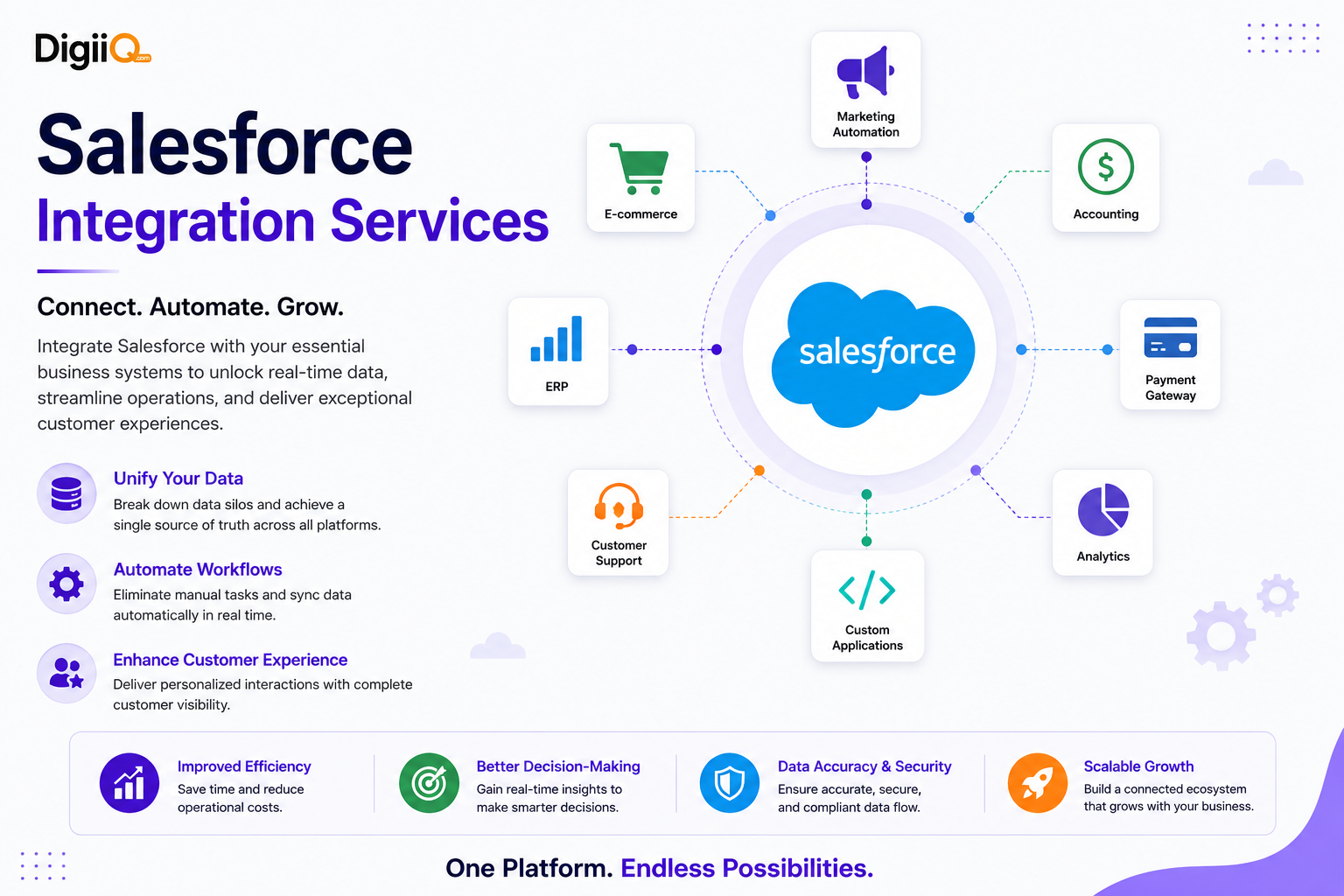
Salesforce integration services involve connecting Salesforce CRM with other software applications to create a unified business environment. These integrations can include ERP systems, marketing automation tools, payment gateways, e-commerce platforms, and third-party APIs.
The goal is to enable real-time data exchange between systems, ensuring that information is consistent and up to date across all departments.
Integration can be achieved using APIs, middleware platforms, or custom development, depending on the complexity of the business requirements.
By integrating Salesforce with existing systems, businesses can create a connected ecosystem that supports efficient workflows and better decision-making.
Benefits of Salesforce Integration for Businesses
One of the biggest advantages of Salesforce integration is improved operational efficiency. When systems are connected, data flows automatically between platforms, reducing the need for manual processes.
This automation saves time and allows employees to focus on more strategic tasks. It also minimizes errors and ensures data accuracy.
Another key benefit is enhanced customer experience. With integrated systems, businesses can access a complete view of customer interactions, enabling personalized communication and faster response times.
Salesforce integration also improves collaboration between teams. Sales, marketing, and support departments can work together more effectively using shared data and insights.
Additionally, real-time analytics provide better visibility into business performance, helping organizations make informed decisions.
Common Salesforce Integration Use Cases
Salesforce integration can be applied across various business functions to improve efficiency and performance.
One common use case is integrating Salesforce with marketing automation platforms. This allows businesses to track campaign performance, manage leads, and align marketing efforts with sales activities.
Another important use case is e-commerce integration. By connecting Salesforce with online stores, businesses can manage orders, track customer behavior, and deliver personalized shopping experiences.
Integration with accounting and ERP systems helps streamline financial processes, including invoicing, billing, and revenue tracking.
Customer support systems can also be integrated to provide a complete view of customer interactions, enabling faster and more effective issue resolution.
These use cases demonstrate how Salesforce integration can transform different aspects of business operations.
Real-Time Data Synchronization
Access to real-time data is essential for modern businesses. Delayed or outdated information can lead to missed opportunities and poor decision-making.
Salesforce integration ensures that data is synchronized across all systems in real time. This means that any updates made in one system are automatically reflected in others.
For example, when a customer makes a purchase, the information is instantly available to sales, marketing, and support teams. This enables businesses to respond quickly and provide a seamless customer experience.
Real-time data synchronization improves efficiency and ensures that all teams work with accurate and up-to-date information.
Enhancing Customer Experience Through Integration
Customer experience is a key factor in business success. Companies that provide consistent and personalized experiences are more likely to build strong relationships and retain customers.
Salesforce integration plays a crucial role in enhancing customer experience by providing a unified view of customer data.
Businesses can track customer interactions across multiple touchpoints, including websites, emails, social media, and support channels. This allows them to deliver personalized communication and anticipate customer needs.
For example, a support agent can access a customer’s purchase history and previous interactions, enabling them to provide faster and more relevant assistance.
By improving customer experience, businesses can increase satisfaction and drive long-term loyalty.
Challenges in Salesforce Integration
While Salesforce integration offers numerous benefits, it also comes with challenges that need to be addressed.
One of the main challenges is data complexity. Integrating multiple systems with different data formats and structures can be difficult.
Another challenge is ensuring data security and compliance. Businesses must ensure that sensitive information is protected during data exchange.
Scalability is also an important consideration. As businesses grow, their integration requirements may change, requiring flexible and scalable solutions.
Working with experienced professionals can help overcome these challenges and ensure successful integration.
Why Businesses Choose DigiiQ for Salesforce Integration
Implementing Salesforce integration requires technical expertise and a deep understanding of business processes. DigiiQ provides comprehensive integration services that help businesses connect their systems effectively.
From planning and development to testing and deployment, DigiiQ ensures that integrations are implemented smoothly and efficiently. The focus is on creating scalable solutions that align with business goals.
By leveraging industry expertise, DigiiQ helps organizations optimize their operations, improve data management, and achieve better results.
The Future of Connected Business Systems
The future of business operations lies in connected systems that enable seamless data flow and real-time collaboration. As technology continues to evolve, integration will become even more critical for organizations looking to stay competitive.
Salesforce will continue to enhance its integration capabilities, making it easier for businesses to connect their systems and leverage data effectively.
Companies that invest in integration today will be better prepared to adapt to future challenges and opportunities.
Conclusion
Salesforce integration services are essential for businesses looking to streamline operations, improve efficiency, and enhance customer experience. By connecting different systems into a unified platform, organizations can eliminate data silos and gain better visibility into their operations.
From real-time data synchronization to improved collaboration and personalized customer experiences, Salesforce integration offers numerous benefits that support business growth.
For companies aiming to achieve digital transformation and scalability, investing in Salesforce integration is a strategic decision that delivers long-term value.
FAQs
What are Salesforce integration services
Salesforce integration services connect Salesforce with other business applications to enable seamless data exchange.
Why is Salesforce integration important
It improves efficiency, eliminates data silos, and enhances customer experience.
Can Salesforce integrate with third-party applications
Yes, Salesforce supports integration with various third-party tools and systems.
Is Salesforce integration scalable
Yes, it can be customized and scaled according to business needs.
Why choose Salesforce integration for business growth
It provides real-time insights, improves collaboration, and supports efficient operations.
